You've been there. You spent a Sunday afternoon designing the perfect chore chart. Color-coded columns. Gold star stickers. Your kid's name in big letters at the top. You hung it on the fridge with pride.
Week one was glorious. Stars everywhere. Kids actually making their beds. You thought you'd cracked the code.
By week three, the chart was buried under takeout menus. The stickers had migrated to the cat. And you were back to asking "Did you clean your room?" four times before dinner.
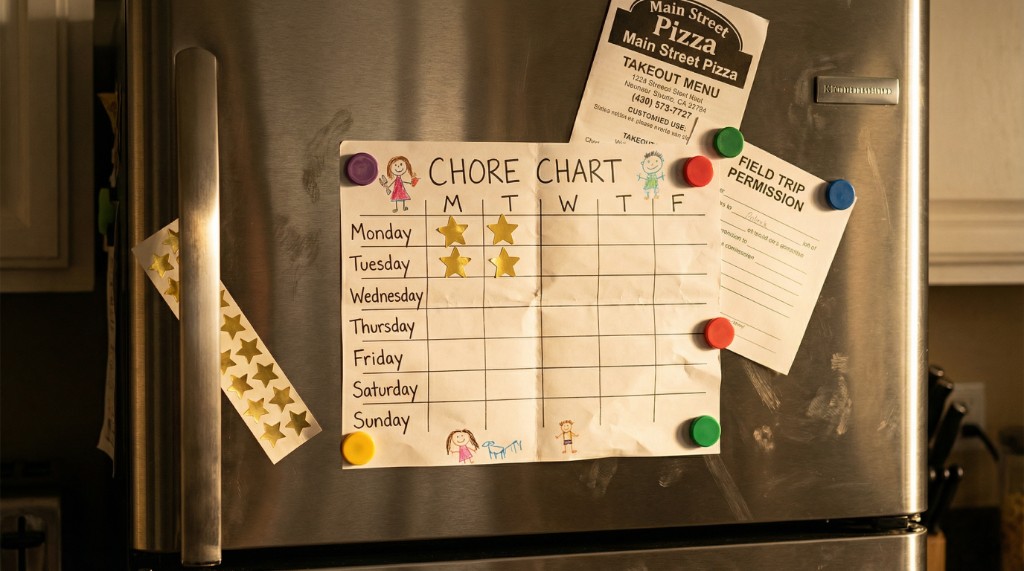
Sound familiar? You're in good company. Chore charts are one of the most common — and one of the most abandoned — parenting tools out there. They work well for some families, especially those with consistent routines and younger children who love stickers. But many parents find that chore charts lose steam after the first few weeks. (To be transparent: we're not aware of published research that specifically tracks chore chart abandonment rates. But the pattern is widely reported by parenting educators and is consistent with what behavioral science predicts about systems that rely on delayed, abstract reinforcement.)
That's not because parents are doing it wrong. It's because the chore chart itself has fundamental design limitations.
The 5 Reasons Chore Charts Stop Working
1. No Feedback Loop
A chore chart is a one-way street. Your kid checks off a box, and … nothing happens. No celebration, no recognition, no response. The chart doesn't cheer. It doesn't notice a streak. It just sits there.
Decades of research building on B.F. Skinner's operant conditioning work have shown that reinforcement is most effective when it's immediate and specific. A sticker added to a chart hours or days after the action doesn't create the strong association between behavior and reward that builds lasting habits. Kids need to feel something closer to the moment — a high-five, a visible number going up, a quick "Great job!" from a parent.
Delayed, generic rewards (stickers at the end of the week) weaken the connection between behavior and reward. The longer the gap between action and recognition, the less effective the reinforcement — especially for younger children.
2. No Sense of Progression
Adults are motivated by progress toward a goal. Kids even more so. But a chore chart resets every week. Monday: empty chart. Friday: full chart. Monday: empty again.
There's no building toward something bigger. No level-ups. No "I'm on day 14 of my streak and I don't want to break it." The chart treats every week as isolated, which means your kid never feels the momentum that turns an activity into a habit.
A 2020 meta-analysis on gamification in education (Sailer & Homner, published in Educational Psychology Review) found small-to-medium positive effects of gamification elements — including progression mechanics like levels and milestones — on both motivation and learning outcomes compared to non-gamified conditions. While this research focused on educational settings rather than household responsibility, the underlying principles of feedback and progression likely apply.
3. One Size Fits Nobody
Your 6-year-old and your 11-year-old have very different capabilities, interests, and motivations. But the chore chart on the fridge treats them the same. Same layout. Same expectations. Same stickers.
The 6-year-old needs simpler tasks with more frequent rewards. The 11-year-old wants autonomy and meaningful goals. A static piece of paper can't adapt to either.
4. Parent Burnout
Here's the underappreciated truth: chore charts don't just require effort from kids — they require constant effort from you.
You have to remember to check the chart. Update the stickers. Print a new one each week. Negotiate which chores count. Handle the "but I DID clean my room!" disputes. Track who earned what reward.
The Bureau of Labor Statistics American Time Use Survey reports that the average person already spends about 2 hours per day on household activities. Adding a chore-tracking system that requires printing, updating, and negotiating on top of that is a recipe for abandonment. In many families, the most common reason chore charts get dropped is that the parents ran out of bandwidth to manage them — not that the kids stopped caring.
The best behavior systems are ones that reduce the parent's administrative workload, not add to it. If the system requires you to be the tracking mechanism, it will fail the moment you have a busy week.
5. No Connection to Real Motivation
What does a gold star actually mean to a kid? Can they trade it for anything? Does it get them closer to something they want? Usually not — it's an abstract symbol disconnected from anything the child actually cares about.
Effective reinforcement ties effort to outcomes the child values. "You earned 20 points today — you're 15 points away from choosing the family movie on Friday" is far more motivating than a sticker that means nothing concrete.
What the Research Says Actually Works
If chore charts have these limitations, what's the alternative to chore charts? The AAP's policy statement on effective discipline broadly endorses positive reinforcement over punishment as a discipline strategy. While their statement addresses discipline broadly rather than chore systems specifically, the underlying principle — that encouragement works better than coercion — informs the following design principles drawn from decades of behavioral research:
Principle 1: Immediate, Visible Feedback
When a child completes a task, they need to see a result quickly. Not a sticker sometime later — a response the same day. Points appearing on screen. A parent's verbal praise. A visible number going up. Research on temporal discounting — including Steinberg et al.'s study on age differences in future orientation (originally studying risk-taking decisions, but the underlying cognitive finding applies broadly) — consistently shows that children discount delayed rewards more steeply than adults do. The shorter the gap between effort and recognition, the stronger the habit-building effect.
Principle 2: Meaningful Progression
Instead of weekly resets, kids need a system that accumulates over time. Think about what makes progress systems engaging in any context: you level up, you unlock achievements, you build streaks you're proud of.
The same psychology applies to responsibility. When a kid sees "Day 14 streak — 3 more days until the next milestone," they're not just doing a chore. They're building something they're proud of. (A note of caution: some children — particularly those prone to anxiety or perfectionism — may find streaks stressful rather than motivating. If a broken streak causes significant distress, it's a signal to de-emphasize streaks and focus on cumulative progress instead.)
Progression systems (levels, belts, streaks, badges) transform one-time compliance into ongoing engagement. Over time, the external motivation helps build a genuine habit — the child starts to see themselves as "someone who follows through."
Principle 3: Personalized Expectations
Different kids need different activity sets, different point values, and different reward menus. A 7-year-old earning points for making their bed is not the same as an 11-year-old earning points for completing homework independently.
The system needs to adapt — by age, by interest, by what motivates each individual child. For younger children (under 7), a simpler physical system with tangible tokens may be more developmentally appropriate than a screen-based app. Point systems and numeric tracking are better suited to children who can understand basic arithmetic and delayed gratification.
Principle 4: Parent Effort Redirected, Not Eliminated
The best systems don't remove the parent from the equation — they redirect parent effort from administrative busywork to meaningful connection. Instead of tracking stickers, the parent's role becomes: approve and celebrate.
This flips the dynamic. Instead of the parent nagging, the child comes to the parent saying "I finished! Can you approve it?" The system handles the logistics; the parent focuses on the warm, specific praise that developmental research shows matters most.
Principle 5: Tangible, Earned Rewards
Points need to mean something real. When a child can see that 50 points earns them a movie night and they currently have 38 — that's motivation. They can calculate exactly what they need to do. It teaches delayed gratification, math, and goal-setting all at once.
One More Thing: Modeling Matters Most
No reward system — no matter how well-designed — replaces the most powerful teacher of responsibility: seeing the adults in their lives model it every day. Research on observational learning (Bandura, 1977) consistently shows that children are deeply influenced by the behaviors they observe in their parents. A point system works best when it's layered on top of a household where adults demonstrate the behaviors they want to see.
But Wait: Won't Rewards Create Dependency?
This is a fair and important question. Self-Determination Theory (Deci & Ryan) — one of the most well-researched frameworks in motivation psychology — warns that extrinsic rewards can undermine intrinsic motivation. A landmark meta-analysis of 128 studies (Deci, Koestner & Ryan, 1999) found that tangible, expected, contingent rewards reliably reduced intrinsic motivation for tasks people already found interesting. This is a real finding, and anyone designing a reward system for children should take it seriously.
Here's the important distinction: the risk is highest for tasks a child already enjoys (creative projects, cooking, helping with pets) and lowest for tasks they find genuinely tedious (cleaning their room, taking out the trash). A well-designed system should be cautious about rewarding activities children already find intrinsically interesting — you don't want to turn a labor of love into a transaction. For boring-but-necessary tasks, extrinsic rewards carry much less risk.
The nuance also lies in how rewards are used. Research distinguishes between controlling rewards ("Do this or no screen time") and autonomy-supportive rewards ("Here are your activities — you choose when and how to do them, and here's what you can earn"). The latter preserves the child's sense of choice, which SDT identifies as a core psychological need.
Some authors and critics — notably Alfie Kohn — argue against extrinsic rewards for children entirely, and their perspective is worth reading. It's also worth noting that gamification elements like streaks and levels can feel controlling if overemphasized — which is why any system should make streaks celebratory rather than punitive, and never penalize a child for breaking one. We believe the practical middle path — informed by the research but ultimately a design choice, not a settled scientific conclusion — is to: use rewards as scaffolding, not a permanent fixture:
- Start with structure. Frequent, visible rewards help kids engage with new behaviors before those behaviors feel natural.
- Pair with genuine connection. Points provide structure and consistency, but the parent's response gives them meaning. The combination — a reliable system plus genuine parental connection — is more powerful than either alone. Try: "I noticed you set the table without being asked — that really helped tonight."
- Gradually fade. As behaviors become habitual — research with adults found a median of about 66 days, though it ranged from 18 to 254 days (Lally et al., 2010; children's timelines may differ) — you can reduce point values or retire activities from the list. The habit outlasts the reward.
The goal isn't to create a child who won't help unless they get points. It's to use a structured system to get the behavior started, then let it become self-sustaining through pride, routine, and family culture.
A note on individual differences: Children with ADHD, anxiety, or other neurodevelopmental differences may respond differently to reward systems. Some may hyperfocus on points; others may find streaks stressful. In multi-child families, be mindful of competitive dynamics — the system is designed for each child to compete against their own goals, not against siblings. If a structured system isn't working for your child despite consistent effort, consult your pediatrician — the issue may be developmental rather than motivational.
Chore Chart vs. Positive Reinforcement System
| Dimension | Chore Chart | Positive Reinforcement System |
|---|---|---|
| Feedback speed | End of week (delayed) | Same-day (points + parent approval) |
| Progression | Resets weekly | Accumulates (levels, streaks, belts) |
| Personalization | Same chart for all kids | Per-child activities, points, rewards |
| Parent effort | High (manage, track, print) | Redirected (approve & celebrate) |
| Reward connection | Abstract (stickers) | Tangible (points → real rewards) |
| Habit durability | Often a few weeks (novelty wears off) | Designed for longer engagement (not yet validated with real users) |
| Multi-child support | Separate charts per kid | Unified system, individual tracking |
| Screen required | No (paper-based) | Yes (brief app interactions) |
| Cost | Free (paper + stickers) | Free tier available; premium optional |
| Simplicity to start | Very simple (draw and go) | Requires initial setup |
What This Looks Like in Practice
Imagine this hypothetical scenario with a 9-year-old named Emma:
Morning: Emma checks her activity list and sees today's tasks: make bed (5 pts), brush teeth (2 pts), pack school bag (5 pts). She does all three and marks them done. Her parent gets a notification.
After school: Emma completes her homework (10 pts) and helps set the table (3 pts). Her parent reviews the submissions and approves them with a tap. Emma sees her updated balance: "25 points today! You're on a 7-day streak — keep it going!"
That evening: Emma sees she has 85 points total. The reward she wants — choosing the family movie on Friday — costs 100 points. She knows exactly what she needs to do tomorrow.
Over time: Not every day goes smoothly — some mornings Emma drags her feet, and one day her parent forgets to approve until bedtime. But most days the system provides structure. After a week, Emma hits a 7-day streak and earns a badge. With 7 perfect days (days where she completed all her activities), she levels up from Yellow to Orange belt. She starts asking to do extra activities — not just for the points, but because she's proud of her progress. The daily nagging has largely stopped.
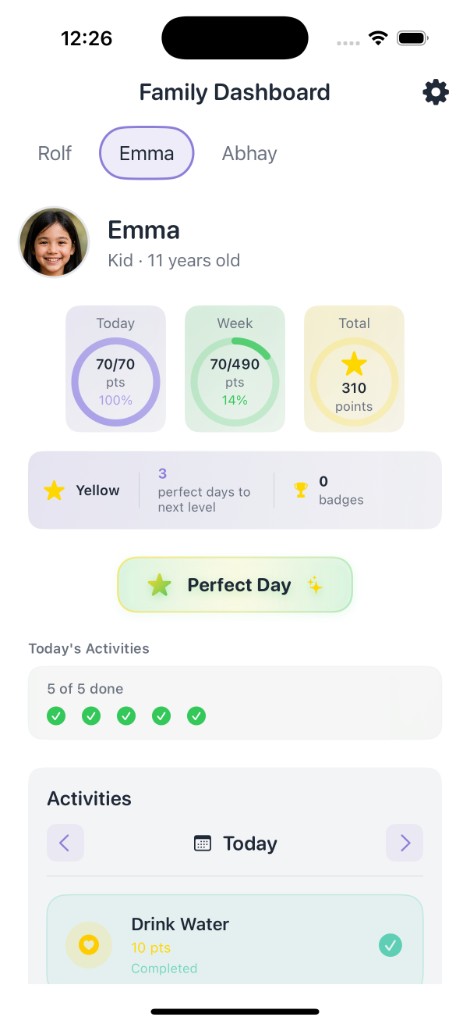
No chart on the fridge. No stickers. No weekly reset. Just a system that keeps both Emma and her parents connected around positive behaviors. (And yes, this involves a screen — but the interactions are brief and purposeful: a few seconds to mark a task done, a few seconds for a parent to approve. Like any app designed to sustain engagement, parents should periodically check whether the system is serving the family or whether the family is serving the system.)
When it doesn't work: Of course, not every family's experience looks like this. Some kids will game the system by marking tasks done they didn't do. Some parents will fall behind on approvals and the system goes stale. Some children simply don't respond well to point-based motivation. If you've been consistent for a month and it's not clicking, that's useful information — it may mean your child needs a different approach entirely, whether that's a simpler physical system, a conversation-based approach, or professional guidance.
The parent's role shifts from "chore enforcer" to "achievement approver." Instead of nagging, you're celebrating. The system handles logistics; you handle the relationship.
How to Make the Switch
If you're looking for an alternative to chore charts, these principles can be implemented in many ways — a marble jar, a physical token economy, or a digital tool. The framework works regardless of the medium; a digital system's main advantage is reducing administrative overhead and providing richer feedback. Here's how to get started:
- Identify 5–8 key behaviors you want to encourage. Not just chores — include homework, kindness, personal hygiene, and physical activity.
- Assign point values based on effort, not importance. Making the bed (easy, daily) = 5 points. Studying for a test (hard, occasional) = 15 points.
- Create a reward menu with your child. Let them pick 4–6 rewards at different price points: 20 pts (small treat) up to 150 pts (special outing). Giving them ownership increases buy-in.
- Keep feedback fast. Approve submissions the same day. Celebrate streaks when they happen. Don't let the system go stale.
- Plan the exit. As behaviors become habitual (research with adults suggests a median of about 2 months, though it varies enormously), gradually reduce point values for those activities. Watch for signs the behavior is becoming automatic before pulling back. The goal is a habit, not permanent reward dependency.
The Bottom Line
Chore charts aren't bad ideas — they're a perfectly reasonable first step that many families eventually outgrow. They capture the what (tasks to do) but miss the why (motivation), the how (feedback loops), and the so what (meaningful rewards and progression).
The families who successfully build lasting habits in their kids don't rely on a static piece of paper. They use systems grounded in positive reinforcement: immediate feedback, visible progression, personalized expectations, and tangible rewards — paired with the warm parent-child connection that no app or chart can replace.
The good news? You don't have to build that system from scratch. The behavioral principles are well-established, and tools are emerging to put them into practice. BetterDojo, for example, is an iOS app launching in Spring 2026 that implements these principles — though it hasn't yet been tested at scale with real families, and we'll share what we learn.
Your kid doesn't need another chart. They need a system that makes doing the right thing feel good — and that helps you be part of the celebration.
Frequently Asked Questions
BetterDojo puts all five of these principles into practice — join the free waitlist to be first to try it when it launches.